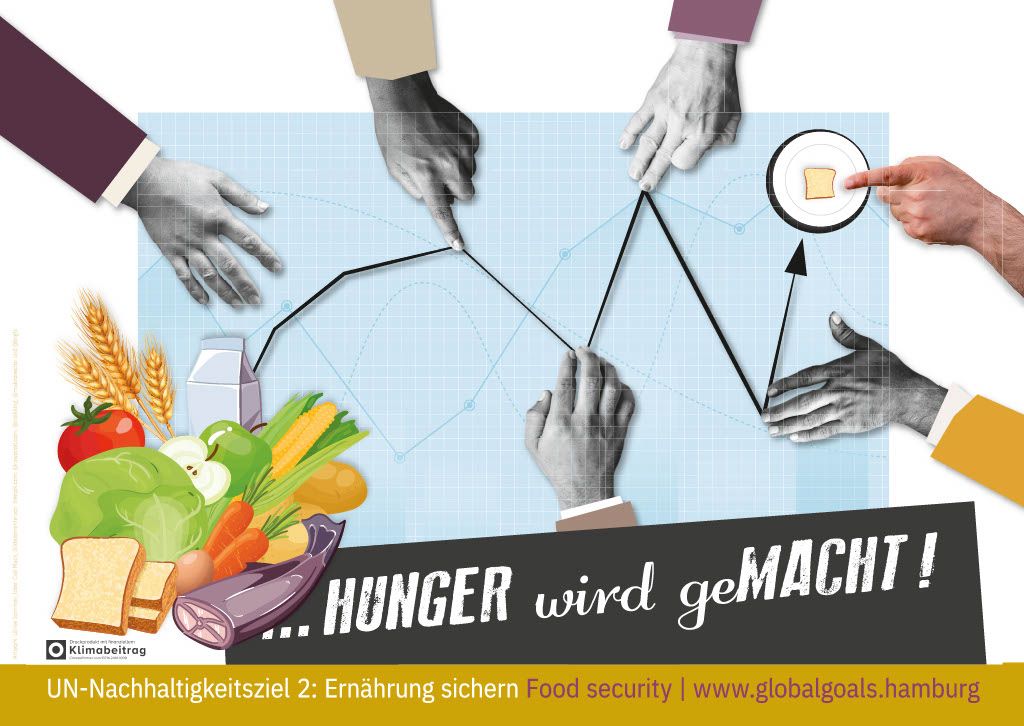
Hunger is the unfulfilled desire for food, a feeling that arises when one does not have what is necessary to adequately nourish oneself. The term hunger describes both the sensation and the condition of malnutrition or undernutrition. It encompasses physical, social, socio-political, psychological, and economic aspects. To end hunger worldwide, as formulated in SDG 2, it is necessary to ensure regular, healthy, and sufficient nutrition – for everyone.
The right to adequate food is one of the fundamental human rights!
Hunger and food insecurity – facts and figures
While the number of hungry people worldwide initially declined after the turn of the millennium, the curve has risen sharply again since 2015 and especially since the COVID-19 pandemic, reaching in 2023 a level comparable to almost 20 years ago. According to various estimates, between 735 and 828 million people—just under 10% of the world’s population – currently suffer from chronic hunger (Global Hunger Index). This means: about one in ten people on Earth is hungry!
Around 2.4 billion people—and thus a good 30% of the world’s population—are affected by moderate to severe food insecurity. They not only suffer constant hunger, but due to inadequate and unbalanced diets also experience a persistent lack of essential nutrients such as iron, iodine, zinc, or vitamins.
The consequences of this “hidden hunger” are not necessarily visible at first glance. In the long term, however, nutrient deficiencies lead to serious diseases and an increased risk of death. It harms not only the individual but can hinder the entire (sustainable) development and economy of the affected regions. Those affected become ill more quickly, are weakened over time due to lack of food, and are limited in their physical and mental performance abilities. Three quarters of all hungry people live in rural areas.
According to the Global Hunger Index (GHI) 2023, the hotspots of hunger are in sub-Saharan Africa and South Asia. According to the report, the hunger situation is particularly severe in the Central African Republic, the Democratic Republic of the Congo, Lesotho, Madagascar, Niger, Haiti, and Yemen, although for some countries there is not always sufficient data to calculate the GHI. The nutritional situation in Burundi, Somalia, Burkina Faso, South Sudan, and Pakistan is also classified as very serious.
“More than a quarter of a billion people are on the brink of starvation,” states the Global Report on Food Crisis (May 2022). And the situation has not improved since then…

“World agriculture could easily feed 12 billion people. This means that a child who dies of hunger today is being murdered.”
(Jean Ziegler, former UN Special Rapporteur on the Right to Food)
Hunger is man-made: causes and structural–systemic conditions
While some countries have been experiencing hunger crises for decades—often with little attention from the public—the topic has recently returned more strongly to public awareness due to current wars (Ukraine, Nagorno-Karabakh, Gaza Strip). Russia’s war of aggression against Ukraine has, among other things, brought grain production and exports from the Black Sea region, the “breadbasket of the world,” almost to a standstill. At the same time, the deliberate withdrawal of food is being used as a weapon to coerce war objectives: food transports are blocked, supply chains disrupted, agricultural cultivation prevented, and people starved.
Increasingly, the media also report on the growing and tangible effects of advancing climate change—such as droughts, heat waves, floods, unpredictable rainfall, strong temperature fluctuations, and other extreme weather events—and their impact on food production (crop failures, destroyed grazing and cultivation areas, lack of animal feed). As a result, the food crisis is once again moving more prominently into public consciousness.
Since 2020, the number of undernourished and hungry people worldwide has surged due to the COVID-19 pandemic. The reasons include shortages in food supply, loss of income, rising prices, and increasing social and economic inequality.
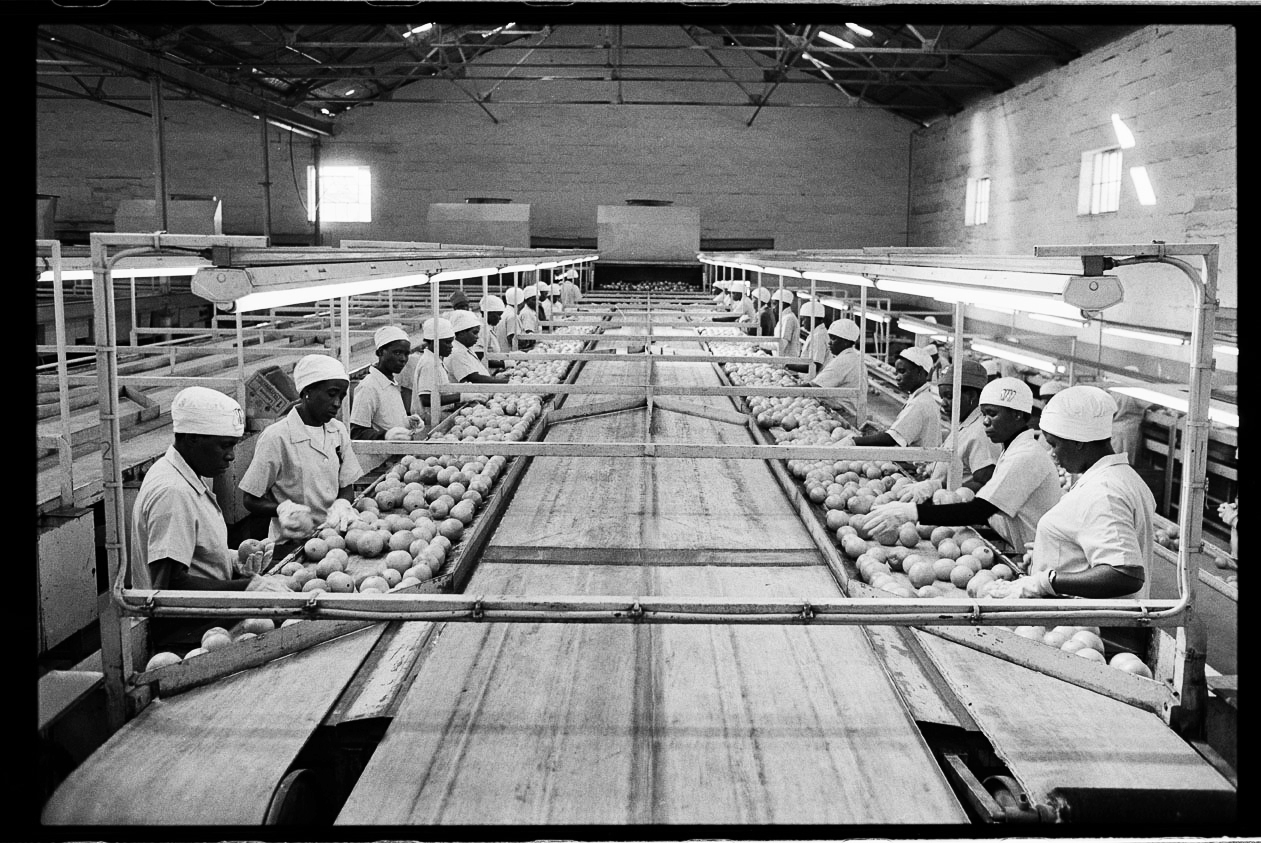
Photo: William Matlala
Speculation in agricultural commodities—often staple foods such as maize and wheat—is partly responsible for the sharp price increases of recent years and thus contributes to global food crises. Financial advisers promote agricultural commodities as investments promising high returns. By betting on the price development of staple foods, investment banks and funds drive prices upward. Rising food prices mean less food for poor population groups and often trigger hunger crises (foodwatch).
“Hunger kills roughly 100,000 people worldwide every day. Hardly anyone speaks about this genocide, let alone about remedies. Against this backdrop, and in view of the unrestrained neoliberalism of the financial markets, the talk of the powerful about Christian values, solidarity, and justice reveals itself as pure hypocrisy.” (Jean Ziegler)
For more on the global food crisis, see also here.
Further information can be found at the World Food Programme, Welthungerhilfe, FIAN, in the Kritischer Agrarbericht 2023, or in the international project FoodUnfolded.
see also: Goal 2 – Fast facts
UN Sustainable Development Goal 2 aims to
end hunger worldwide, achieve food security and improved nutrition, and promote sustainable agriculture.
Its subtargets include: ensuring access for all people to safe and nutritious food; ending all forms of malnutrition; doubling the productivity and incomes of small-scale farmers; promoting sustainable food production and resilient agricultural practices; and preserving genetic diversity in food production.
This is to be achieved through investments in rural infrastructure, agricultural research, technology and gene banks; through preventing agricultural trade restrictions, market distortions, and export subsidies; and through ensuring stable food commodity markets and access to information for all stakeholders.
However, the current UN Hunger Report makes it clear that the world is not on track to achieve these goals and end hunger by 2030. Instead, it is expected that 600–800 million people will still suffer from chronic hunger by then (UN Report on Food Security in the World 2022).
Possible solutions
To prevent this, a cross-sector effort is needed involving politics, the agricultural sector, farmers’ associations, and civil society—and with the participation of all countries—to initiate a fundamental systemic transformation in agricultural, trade, and economic policy:
towards healthy, sufficient, and nutrient-rich food accessible to all; towards fair and inclusive value chains; towards strengthening the resilience of producer countries in times of disruptions and crises (wars, natural disasters, pandemics); and towards greater climate justice.
This global task is enormous and encounters considerable resistance—for example, from local farmers who fear or already experience significant losses due to the reduction of agricultural subsidies. But there are also farming enterprises here that advocate for new thinking and different agricultural policies and that lead by example.


Get Involved with initiatives and organizations working for a sustainable transformation of food and agricultural systems.
Rescue and Share Food
- foodsharing.de: an international movement advocating mindful use of resources and sustainable food systems
- Zu gut für die Tonne: an initiative to share leftover food and stop food waste
- Too Good to Go: an app to rescue unsold food from shops and restaurants
Campaigns
- Wir haben es satt!: Alliance for an alternative agricultural policy
- Slow Food Movement: promotes socially and ecologically responsible food systems, protecting biocultural diversity, animal welfare, climate, and the environment
- Gutes Essen macht Schule (Hamburg): Initiative for a food system transformation in Hamburg and healthy nutrition in schools and other public institutions
NGOs working on food security, emergency hunger relief, and/or raising awareness
- Agrarkoordination – Forum for international agricultural policy
- FIAN – fighting hunger through human rights
- Welthungerhilfe – for a world without hunger
- Oxfam – for a world without poverty
- Foodwatch – the food rescuers