Story of SDG 8: Decent work and economic growth

“We’re going back one more time…”
While the existing mural motifs were presented in July 2024 on the fringes of a major arts and culture festival, we took a look at further works by artists on the exhibition meadow. The participatory nature of the mural project means always being out and about with open eyes and ears. It is about noticing formats, art and artists, themes, groups, and initiatives that could be integrated into the project.
The brief exchange at the end of the walk concluded with the sentence: “Come on, let’s go back one more time.” Going back meant: back to the booth of the artist LAPIZ, who until then had been unknown to us. His works had caught our eye, yet it took a bit of courage to approach the man behind the images. It didn’t take long before we had arranged to meet. Further encounters followed, and it became clear that the collaboration with LAPIZ and his fellow artist Elmar Karla would result in a mural motif addressing the complex and contradictory SDG 8.
Below, they explain their approach and considerations in developing the motif. (LAPIZ speaks in more detail about his engagement with SDG 8 in this fokusglobal podcast.)
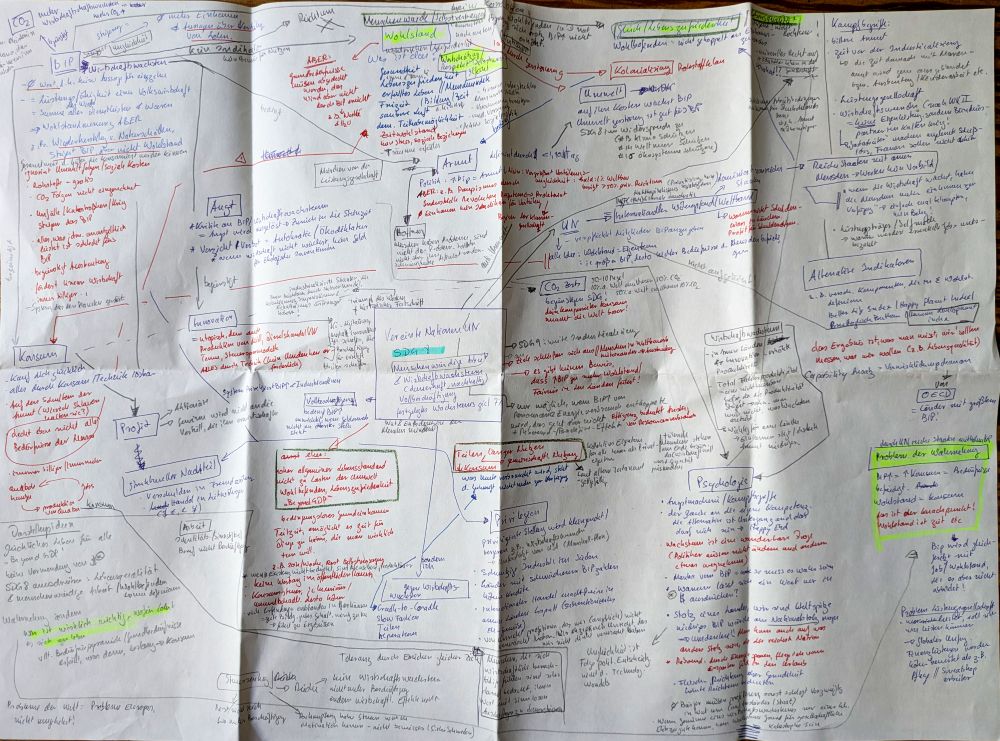
“It was clear that the topic would not be an easy one, and so the research phase began: poring over literature, watching documentaries, reading books. We both used different sources; for LAPIZ, the book Good Economics for Hard Times: Better Answers to Our Biggest Problems by Nobel Prize winners Abhijit V. Banerjee and Esther Duflo was particularly impactful. From the many sources, a mind map was created to help us gain an overview. When we develop motifs, we try to find out what it’s really about—what is the core message? The topic of SDG 8 is so complex that we have to focus on a single point. So what is the crux of the matter?
Often Simply
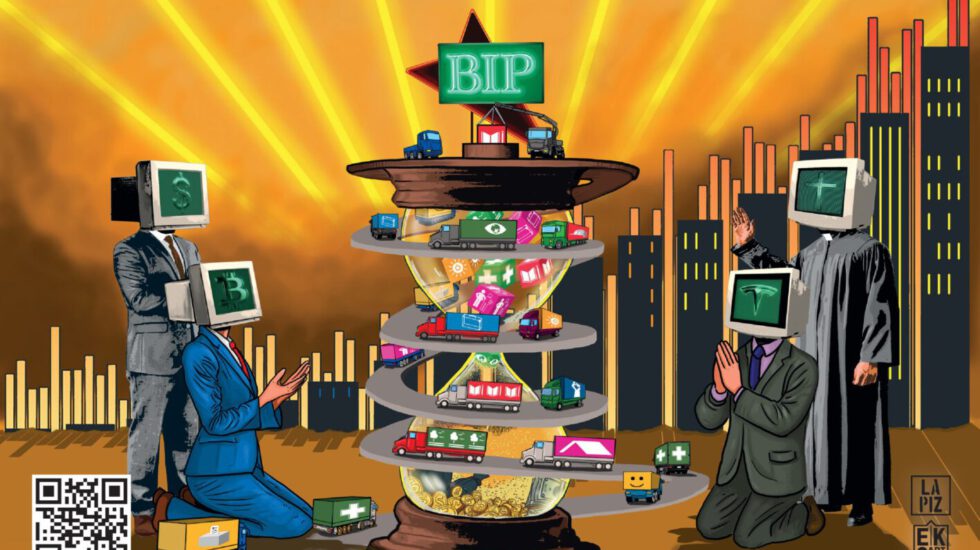
“When you engage with economic growth, there is one word that is always mentioned and that serves, almost automatically, as the justification for all economic activity: PROSPERITY. There is a lot of talk about this ‘prosperity,’ but the term itself is rarely defined. ‘The economy has to grow, otherwise we risk our prosperity,’ is something that is often stated quite simply.
Since the economy does not provide a definition, we considered for ourselves what prosperity could mean: a happy life for everyone (as measured, for example, by the state of Bhutan through its Gross National Happiness), the freedom to determine how we use our own time, opportunities for self-realization, decent work, an intact natural environment, (free) education, affordable housing, art and culture, justice, a livable planet, democracy, and more. It is precisely these achievements that are threatened and sacrificed in the pursuit of an ever-higher GDP.
That this is a contradiction can be seen in a statement made by the former Federal Chancellor at an employers’ meeting in October 2024: ‘This has to go.’ What was meant was the so-called Supply Chain Act, which had only just come into force and is intended to ensure corporate responsibility in global supply chains. This includes environmental protection, fair wages, occupational safety, and protection against child labor. Hardly in force, the law is already being debated again because it allegedly impairs economic turnover – so away with it.
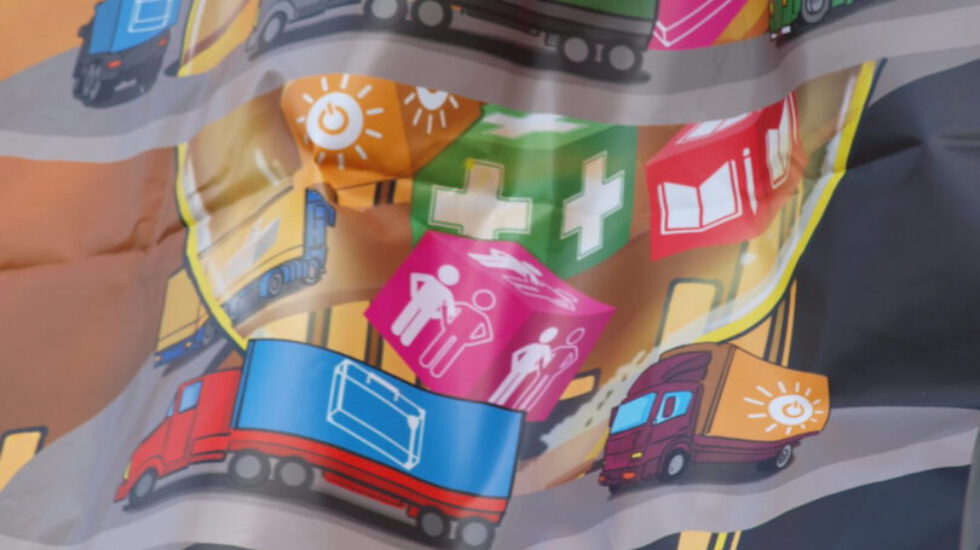
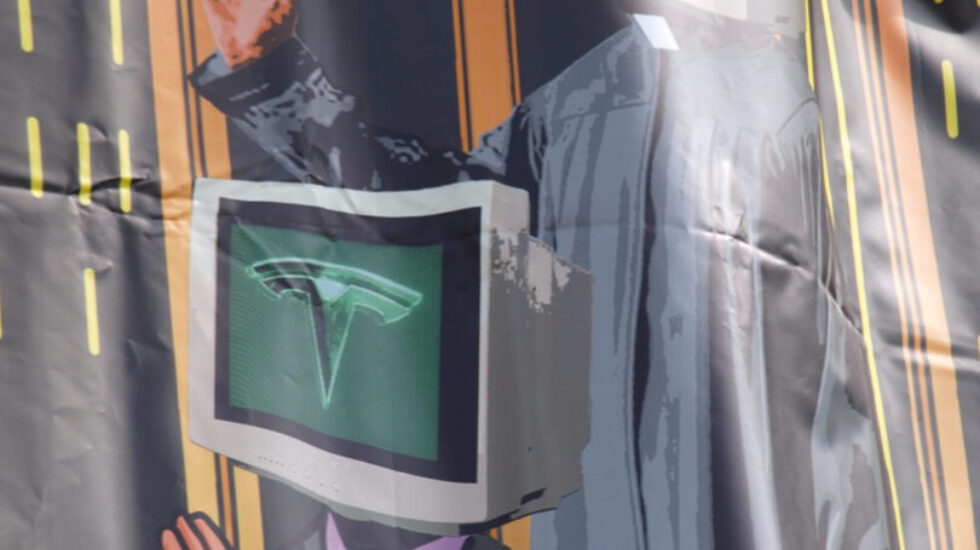
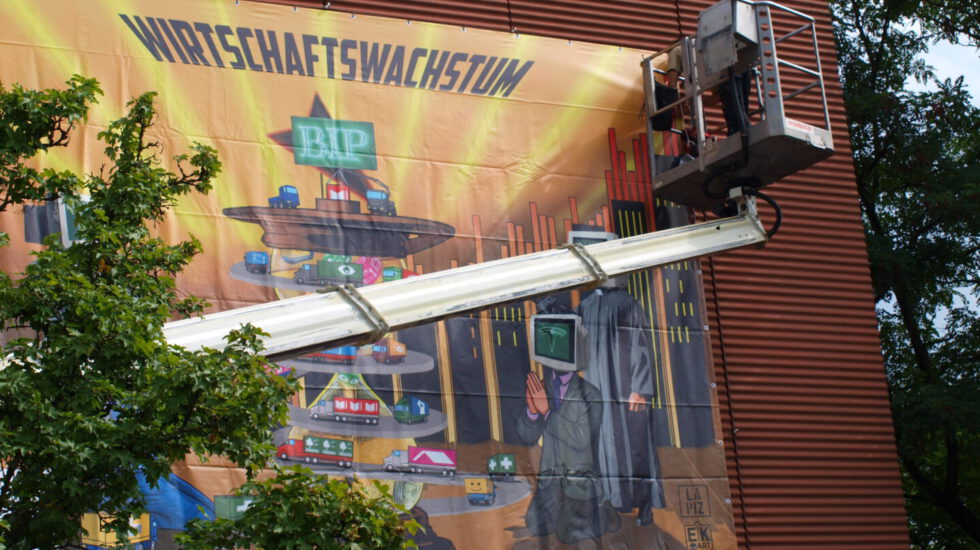
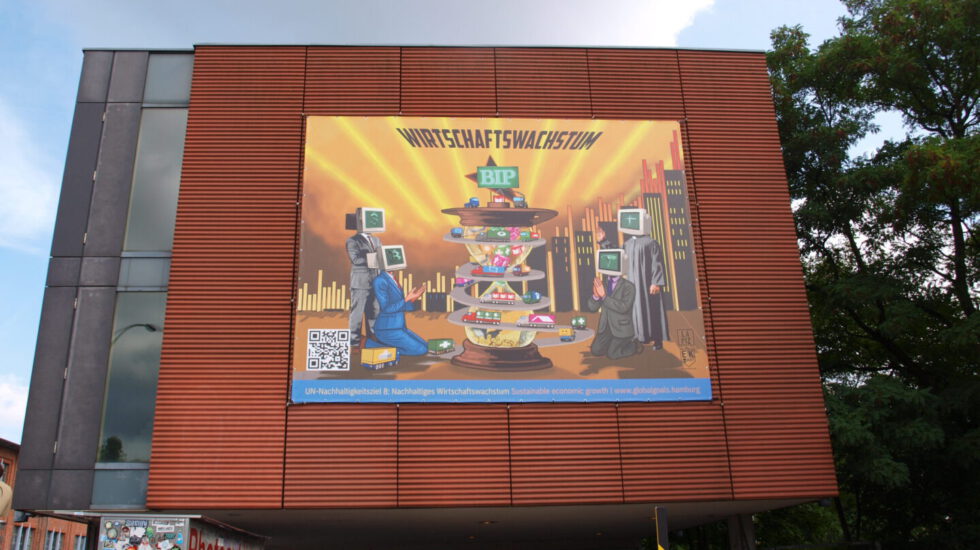
The image is intense; everything is technical. There is no nature, no people—only an industrialization of the mechanisms of economic growth. Many contemporary works aim to present a positive solution, a way out, so that viewers are left with the feeling that perhaps not everything is so bad. This is not the case here. There is nothing positive about this topic – but there is a way out: rethinking.”
“Political art is representational…,” LAPIZ says in the fokusglobal podcast, where he explains in more detail the complexity of the working process, the content, positions, and discussions that fed into the mural motif.
After the design by Elmar Karla and LAPIZ was completed, various stakeholders from the fields of media literacy, supply chain legislation, fair trade, and the economy for the common good were invited to an expert exchange in order to contribute their expertise and perspectives to the discussion.
The intensive engagement with GDP and the Supply Chain Act resulted in another motif by LAPIZ entitled “Fortschrittlos – No Progress,” which can be seen in Berlin at the Urban Canvas parking garage (curated by Liebe zur Kunst).
To make the SDG 8 mural accessible beyond its place of origin, the mural was reproduced as a risograph print.
These prints are available in a limited edition and can be purchased via this link.

Title: Growth or Prosperity
Four-color risograph print, A3 (42 × 29.7 cm), limited edition of 50 copies + 2 AP (artist proofs), signed by LAPIZ and Elmar Karla