Story of SDG 11: Sustainable cities and communities
Future Cities or Urban Futures Will Be Shaped and Planned by All of Us!
What could a sustainable city look like, and who will design it? How can the resources and wealth of a city be distributed and utilized in a climate- and socially just way? What would happen if all residents had equal rights to participate in urban development decisions and in the implementation process? How can structures be created that are emancipatory rather than oppressive, participatory rather than hierarchical? What does everyday life look like in the city of the future, which enables all people in future generations to live a good life both locally and globally?
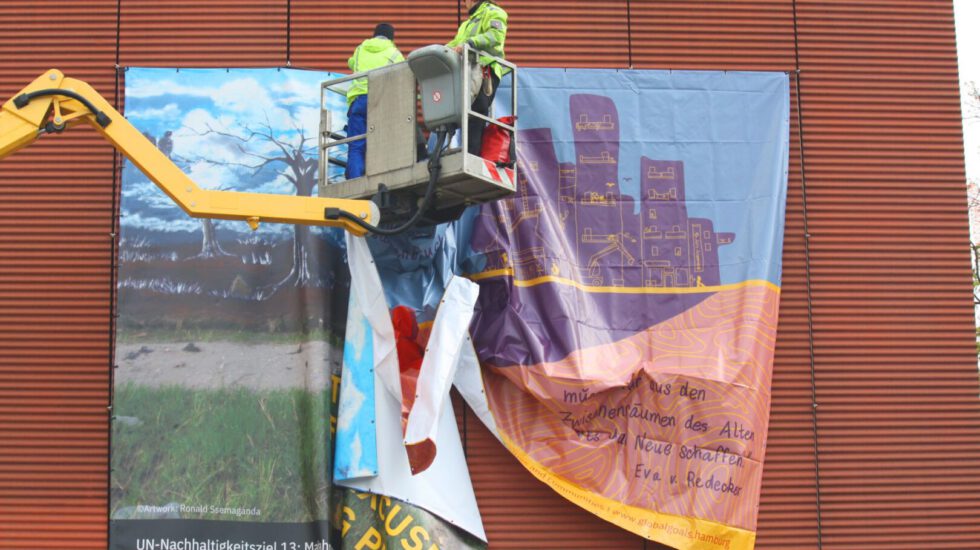
With these questions in mind, we turned to those who, as part of their education and future professional careers, deal with finding answers: aspiring architects, urban designers, and urban planners. We wanted to capture and showcase the visions and ideas of students and graduates from the HCU (HafenCity University) in a new mural design for the UN Sustainable Development Goal 11: “Sustainable Cities and Communities.” The project quickly evolved into an inspiring and nuanced discussion and collaboration – unfortunately, due to COVID-19 restrictions, only carried out digitally – with an interdisciplinary group consisting of Sophia Leipert, Nina Manz, Charlotte Niewerth, and Anna Seum.
Highly inspired by philosopher Eva von Redeker and her 2020 book Revolution for Life, the four designers explained their motivation for participating in the project:
“We see ourselves as politically engaged and have spent a lot of time in our studies critiquing existing urban structures, as well as imagining more just futures. That’s why the opportunity to offer a critical perspective on SDG 11, which deals with urban development, seemed very fitting…”
In the following conversation from May 2021, they discuss their collaboration, the creative process, and the ideas that led to the design of the mural:
Future Cities – Urban Futures
You designed the current mural for SDG 11 as a team. How did you come together as a group?
We are friends, designers from architecture, sociology, and urban design, and we studied together. Due to the COVID pandemic, a lot of things shifted to the digital realm, such as the staging of a play by the Munich Schauspielhaus. To watch this and other cultural events together, and to integrate more cultural perspectives into our daily lives, we began gathering for this purpose. Eventually, Nina came up with the idea: Why not make art together? That’s how it started.

How Did You Hear About the “Global Goals – Locally Designed” Project and What Motivated You to Participate?
We heard about the call to design the mural through Prof. Kathrin Wildner (HafenCity University). As we mentioned, we, as educated citizens, had missed culture in our everyday lives. The idea of creating a mural ourselves was both a welcome change and a challenge for us.
What Role Does Art and Artistic Creation in Public Space Play for You?
Public space should reflect the plural character of the city itself, which unfortunately is increasingly being overlooked – just think of gated communities. Art can be many things and should be treated with a certain ease. However, for us, artistic creation comes with a political claim. This includes critique, but also joy. Art can wonderfully combine these aspects, thus serving as an expression of plurality, making various perspectives visible from different positions. It doesn’t prescribe a particular interpretation but is meant to provoke thought. This visibility is especially important when the perspectives being shown are otherwise marginalized. Thankfully, we can claim less today that our perspective is marginalized than a few years ago, but as feminists, there is still much to do and say.
How Did the Idea for Your Mural Develop? What Messages Did You Want to Convey, and Why Did You Integrate the Quote from Eva von Redeker Into the Design?
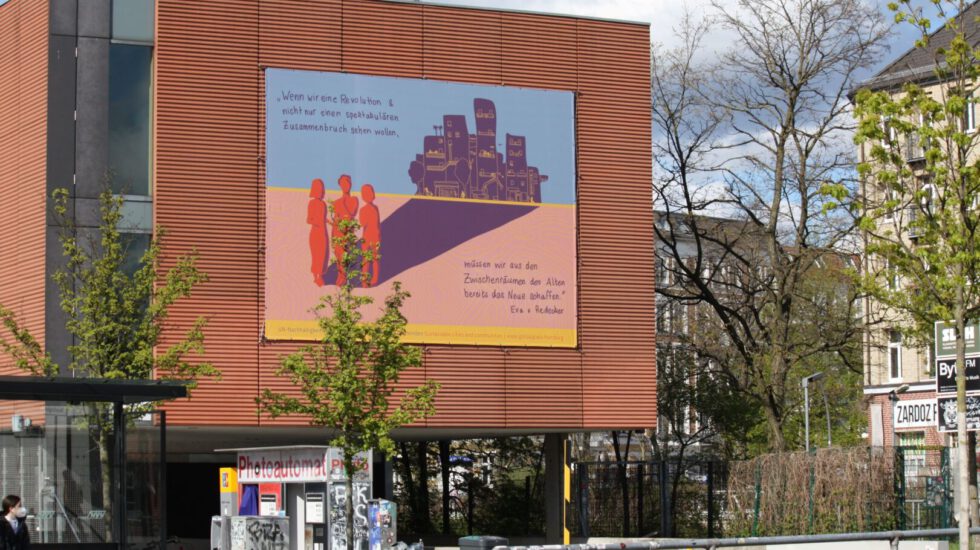
As intellectual and design inspiration for our mural, we used Eva von Redeker’s metaphor of fungal networks – called mycelium – to illustrate interdependent (human and non-human) relationships. She writes:
“Fungi and humans differ in that, among other things, humans can reflect on their behavior through symbolic representation and make decisions. We are not the same beings as fungi. Rather, we are the kind of beings who could decide to be like fungi. Our nature does not determine our lives. Our wildness need not be terror; it can be nourishing, effervescent freedom. This also means that the fear of life does not lead us straight to the sword. We can also begin to form underground connections and fill them with richness. In doing so, we would not only save each other’s lives but also life itself: It would be pulsating interconnectedness, not passive possession.” (Eva von Redeker, Revolution für das Leben, 2020, S. Fischer Verlag)

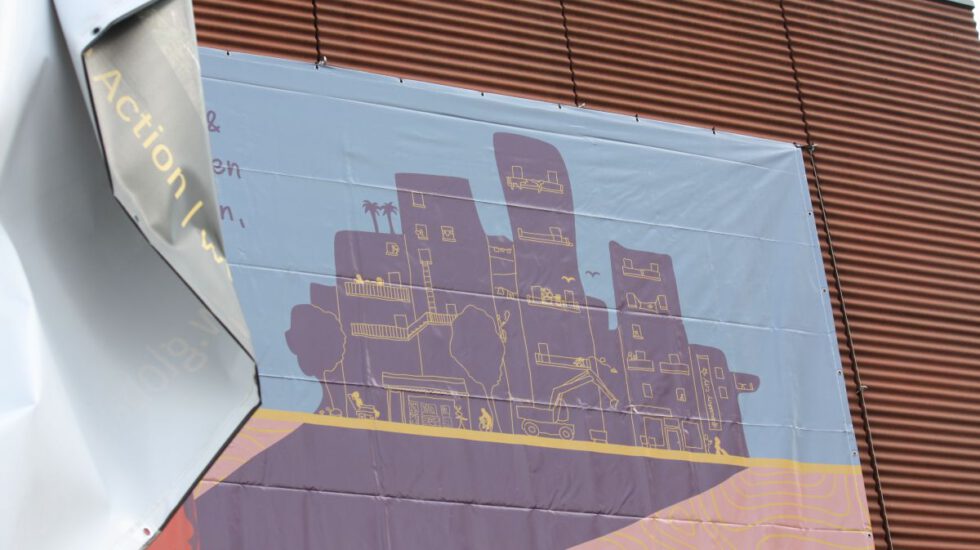
We used her metaphor, which is also employed by African American author RL Watson in relation to the organizational form of Black Lives Matter, at the beginning of the design process to illustrate, highlight, and celebrate the idea of urban structures as spaces of constant exchange. Ultimately, we decided not to incorporate the mushrooms into the visual language, due to some negative connotations and unclear possibilities for differentiation. However, the final image is still inextricably linked to this process, from which we learned a great deal and had many discussions. Those who look closely may still find a reference to this idea in the final image.

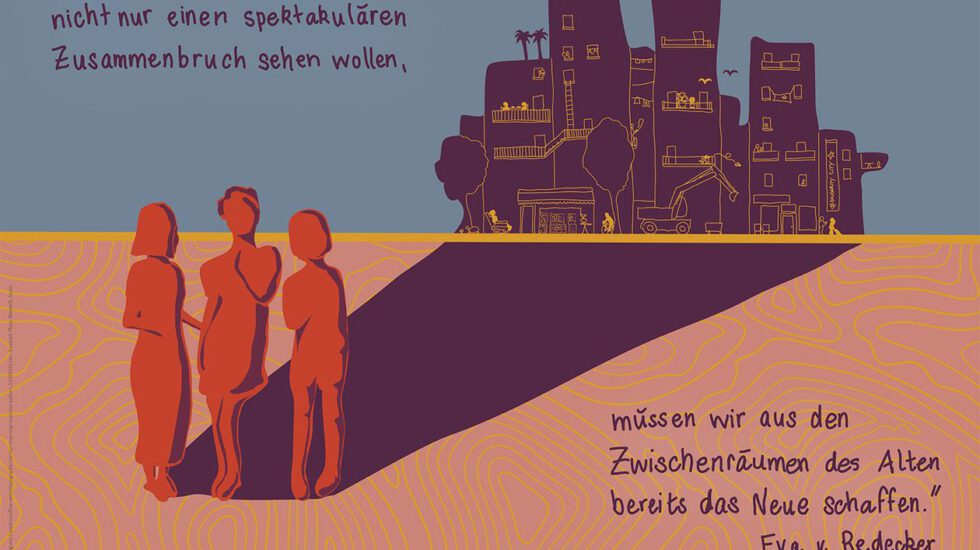
Instead, we engage more directly with the content of this metaphor: the urban structure as a shared space, a collaboratively produced space. By focusing on the imagination of an alternative, we amplify our feminist perspective on the city. The supposed dichotomy between the public and private spheres is an important feminist issue: the home is still the most dangerous place. The process of imagination is solidaristic, not individualistic. The three women imagine and produce at the same time. They – like Eva von Redeker – know that if we want real change, we must start today: for example, by changing our social relationships. For us, this expresses hope and optimism – something we must urgently preserve in the face of the devastating conditions both outside and inside.
The image also shows that we are already practicing much of what we would consider an integral part of a utopia in our daily lives. Practices of care, being there for one another, resistance, protest, and even the building of small projects. The voices calling for fundamental revolutions are growing louder – from Black Lives Matter to the climate justice movement.
What Did the Collaboration on This Image Mean to You?
The mural for SDG 11 “Sustainable Cities and Communities” was created – like the city itself – in process. Through recurring discussion formats with the initiators and us as designers, we sought forms of representation that move beyond criticizing existing urban power and decision-making mechanisms into the realm of the imaginative. Along the way, we were accompanied by discussions, controversies, and frustration, as well as laughter, wine, good food, reflection, and development.
The (digital) collaboration in various configurations was very fruitful for the process, while at the same time, decisions had to be made that could never cover all the issues. Ultimately, we are happy to have found a co-produced solution that both presents a clear motif and hints at the complexity of this topic.
What Inspirations Do You Draw from SDG 11? Where Do You See Challenges or Contradictions in the Goals and the Implementation of This Sustainability Goal?
With SDG 11 come demands not only for the creation of safe, inclusive, just, and sustainable cities but also questions of (in)accessibility to private and public spaces. What concepts of safety and inclusion, for example, underpin the demand for slum rehabilitation? And whose safety is being considered?
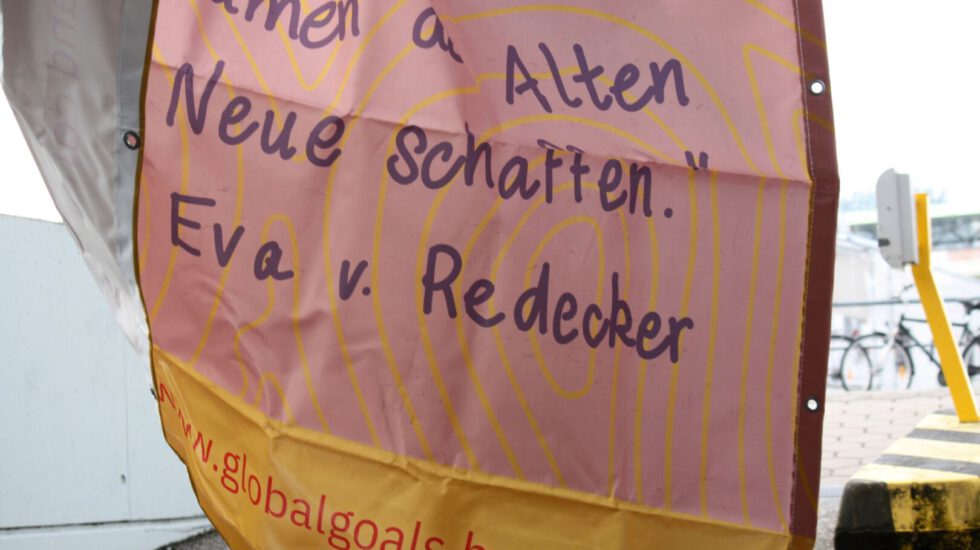
With the image and the quote from Eva von Redeker, we would like to encourage, in light of current developments and projects, to also acknowledge, recognize, and value what already exists. Sustainable urban development always includes social sustainability alongside ecological considerations. Future cities or urban futures will be shaped and planned by all of us – as city residents!