Story of SDG 2: Food Security
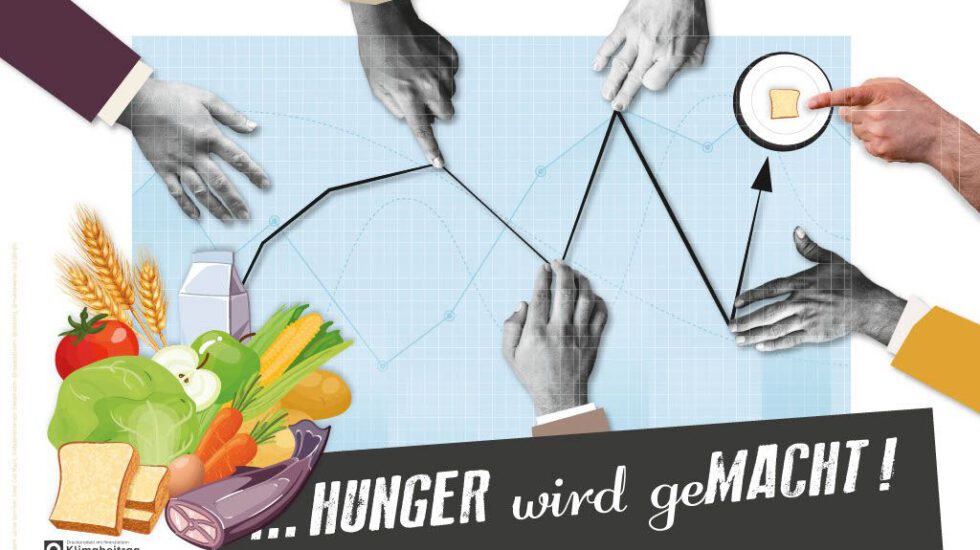

was already addressed a hundred years ago by Bertolt Brecht in his poem “The Three Soldiers and the Wheat”:
„Der grosse Mangel an Weizen und Brot
Macht mehr Leute als der Weltkrieg tot.
Im vorigen Jahr in Amerika
Wuchs überall Weizen, so weit man sah.
Und wenn man ging drei Wochen gradaus
Rechts und links ging der Weizen nicht aus.
(…)
Und als nun endlich im vorigen Jahr
All der Weizen beisammen war
Da kamen fünf reiche Leute einher
Die gossen den Weizen in das Meer.
Denn diesen fünf Leuten gehörte der Weizen so gut
Wie dir dein Stiefel und mir mein Hut.
Und wenn’s zuviel Weizen gibt aut der Erd
Dann ist er nicht mehr soviel wert
Denn etwas, wovon es zu viel gibt
Wird schlecht bezahlt und ist nicht beliebt:
Da kaufen die Leute dann nichts und laufen
Woanders hin, wo sie es billiger kaufen.
Drum sagten die reichen Leute verdrossen:
Der Weizen wird in das Meer gegossen.
(…)
From: Bertolt Brecht & George Grosz. The Three Soldiers. A Children’s Book. 1932
The full, highly relevant text can be read HERE (only in German).
An SDG that repeatedly came up in our engagement with the UN Sustainable Development Goals was SDG 10: “Reduce inequalities within and among countries.” During the COVID-19 pandemic, global inequalities between countries became particularly visible. But even in our exploration of topics such as “Health,” “Poverty,” or “Consumption” and the other SDGs, we kept returning to how fundamental this issue is for all SDGs. After an expert discussion on SDG 10 and a very engaging conversation with the political economist Christoph Ernst about colonial continuities and the historical background of global inequalities, we began developing ideas for a corresponding motif. However, we quickly realized that the topic was so broad that we could not easily agree on a specific focus and would need more time and research for its visual implementation.
Therefore, we decided to put it on hold for the time being and instead dedicate ourselves to another topic we had already explored more thoroughly in relation to the motifs for SDG 1 (End Poverty) or SDG 3 (Health and Well‑Being): namely, the issues of “Hunger” and “Food Security” as enshrined in SDG 2.
The starting point for our considerations was the analytical thesis, supported by various political and social scientists, that hunger is not fate but man‑made—and therefore fundamentally changeable. This thesis is particularly well‑documented by the Swiss sociologist Jean Ziegler, who, among other roles, served as the UN Special Rapporteur on the Right to Food until 2008. In an interview with Deutschlandfunk (only available in German), he stated: “Speculation on food kills people!”
For a brief moment, we considered placing only the sentence “Hunger is MADE” in white letters on a black background on the mural banner, but we soon abandoned this idea.
During further research on the topic, we came across the platform foodunfolded, supported by the European Institute of Innovation and Technology (EIT). foodunfolded draws attention to how closely our food is intertwined with our lives and society. After an exchange on the subject, the initiative provided us with one of their graphic ideas for further development.
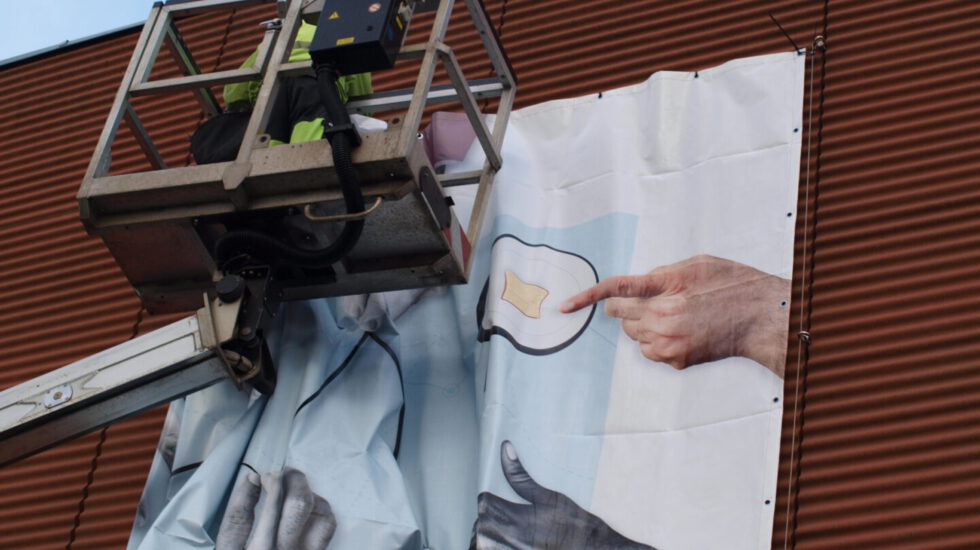
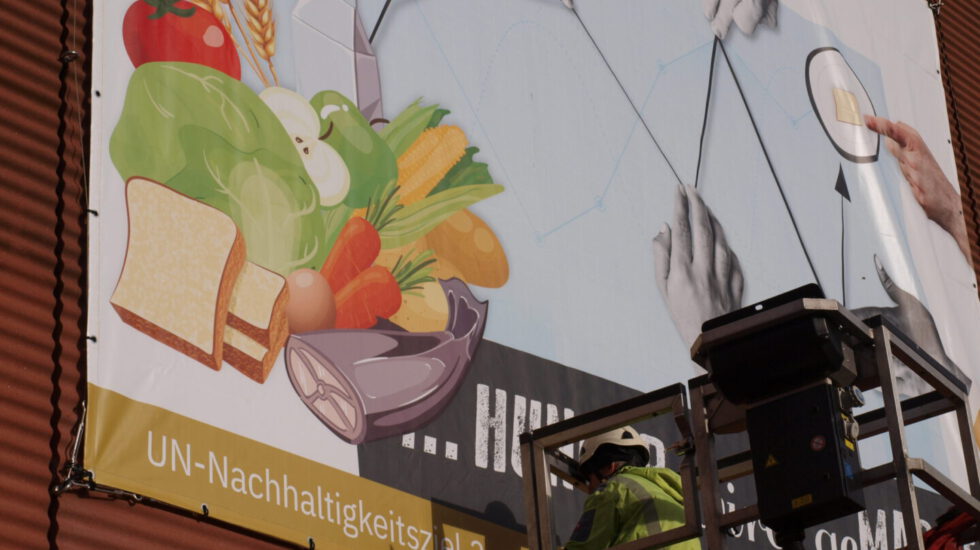
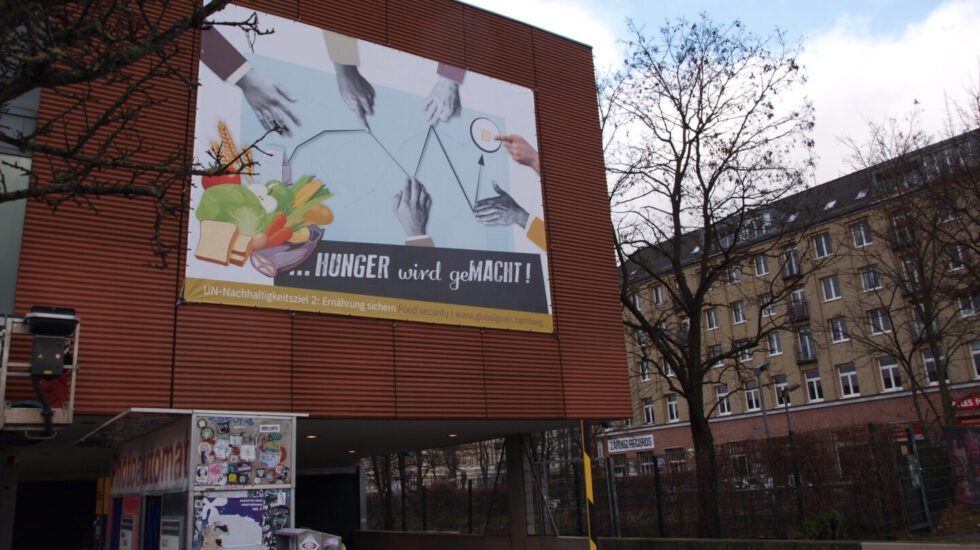
Ultimately, the motif for SDG 2: “Ensure Food Security” was created in close collaboration with the foodunfolded team. We sincerely thank them for this cooperation, in which we were able to use, adapt, and further develop a motif originally created by the graphic designer and artist Cait Mack as the conceptual basis for the mural! Our thanks also go to the graphic designer Ulrike Sommer, who has been contributing both content and design expertise to the murals for many years and played a key role in implementing this new motif with her ideas and skills.