
Water is a finite and increasingly scarce resource. It is essential for the survival of humans, animals, and plants and is needed for drinking, food preparation, cleaning and personal hygiene, healthcare, food cultivation, animal husbandry, industrial production, and energy supply. About two-thirds of the Earth’s surface is covered by water, but only approximately 2.5% of it is drinkable.
Since 2010, the “right to water and sanitation” has been recognized as a human right and a prerequisite for the fulfillment of other human rights, such as the rights to life, food, protection from hunger, and health and physical integrity. According to the World Health Organization, only when a person has access to approximately 50 liters of water per day can health risks be considered minimal. In Germany, around 130 liters per person per day are consumed. While access to clean water and proper sanitation is taken for granted by most people, it remains out of reach for others. In some countries, people must manage on only 5 liters of water per day, often having to carry it over long distances.
“We shall not finally defeat AIDS, tuberculosis, malaria, or any of the other infectious diseases that plague the developing world until we have also won the battle for safe drinking water, sanitation and basic health care.” – Kofi Annan, former UN Secretary-General
Water and Sanitation: Facts and Figures
Traditionally, women are primarily responsible for providing drinking water for their families and preparing food. The lack of toilets affects them more than men—not only for health and hygiene reasons but also because using open spaces for toileting carries many risks, especially at night. Nevertheless, in many places, women are not allowed to participate in decisions regarding the creation and management of water and sanitation services.
Around 2.2 billion people worldwide have no access to safe drinking water, while over 6 billion do have access. An estimated 2 billion people have no way to wash their hands with water and soap, including 653 million who have no handwashing facilities at all. Approximately 3.5 billion people do not have safe sanitation at home (UNICEF, World Water Day Report 2025, data as of 2023). These conditions primarily affect the economically weakest groups in countries of the Global South, particularly in rural areas. Often, people must rely on contaminated river or lake water for drinking, cleaning, and food preparation.
Contaminated water often contains pathogens that cause typhoid or cholera. Stagnant water in open areas such as lakes or puddles can serve as breeding grounds for mosquitoes, which can transmit dengue fever, malaria, or other infections.
Fecally contaminated water also leads to severe health consequences, particularly diarrheal diseases. These remain one of the leading causes of death across all age groups, especially among young children and the elderly. In 2021, there were 1.2 million deaths worldwide due to water-related diarrheal diseases. This represents a significant decline compared to the 1990s, particularly among children under five years old. Diarrheal diseases weaken the immune system, making the body more susceptible to other illnesses.
Therefore, proper sanitation is especially important for infants, sick, and vulnerable individuals. Diarrheal and other diseases in early childhood can lead to malnutrition, developmental delays, and underweight. Sick children and adolescents may be unable to attend school, and sick adults may be unable to work fully. SDG 6 is therefore closely linked to other SDGs, such as health (SDG 3), education (SDG 4), gender equality (SDG 5), life below water (SDG 14), and sustainable economic and consumption practices (SDG 8, 12).
Global Water Consumption
According to scientific studies, there is globally enough freshwater available to provide all people with sufficient clean drinking water. The causes of scarcity in natural water resources are primarily due to unequal access to and consumption of (clean) water. Additional factors include widespread pollution and overuse of existing water resources by (agro-)industry, excessive per capita water consumption in some regions, inadequate or missing water protection measures, insufficient wastewater treatment, the discharge of industrial and agricultural pollutants (pesticides, manure, pharmaceutical residues, etc.) into rivers and groundwater, and excessive water use in the production of water-intensive goods (food, clothing, energy, etc.).
Worldwide, approximately 4,000 km³ of freshwater are withdrawn annually. About 70% of this is used in agriculture, 20% in industry (including energy production), and 10% at the municipal level. Additionally, around 6,400 km³ of rainwater falls directly on agricultural fields. However, in North America and Europe, the industrial share of water withdrawal is about 50%, and in Western Europe, it exceeds 70%.
Global water consumption increased roughly sixfold between 1930 and 2000 (tripling of the world population and doubling of average per capita water use). The ten countries that withdraw the most water are India, China, the USA, Pakistan, Indonesia, Iran, Vietnam, the Philippines, Japan, and Mexico. Together, these top ten countries account for two-thirds of global water withdrawals – India (19%), China (15%), and the USA (12%) alone make up nearly half (47%) (Federal Agency for Civic Education, 2020).
Climate change further exacerbates water scarcity: with a global warming of three degrees, approximately 10% of the world population could face absolute water shortages. One reason is the alteration of the water cycle, affecting rainfall and evaporation patterns due to climate change. Extreme rainfall events, changing rain cycles, and droughts threaten water security, and climate-related extreme weather events can destroy or compromise water resources. Naturally occurring toxic substances (e.g., arsenic) leaching from rock formations into drinking water can also contaminate freshwater.
Around the world, conflicts regularly arise over the distribution, use, and protection of water resources (for examples, see Der Wasseratlas, 2025). A well-known case is the so-called “Water War in Bolivia” in the city of Cochabamba (2000). A sharp increase in water prices due to privatization of water supply led to months of demonstrations and street clashes, resulting in several deaths and many injuries. The Bolivian government eventually had to reverse the privatization.
The Global Economy and the Water Footprint
Water issues are closely linked to the structure of the global economy. Many countries have largely externalized their “water footprint” (available in German only) by importing water-intensive goods from other countries. This means that they have also outsourced their water consumption through the production of food (including livestock) and industrial products. This puts pressure on the water resources of the exporting regions, where mechanisms for adequate water management are often lacking.
For example, Germany’s water footprint amounts to approximately 1,430 km³ per capita annually, about 69% of which occurs outside its national borders. At the same time, Germany also “exports” significant amounts of water through its industrial production.
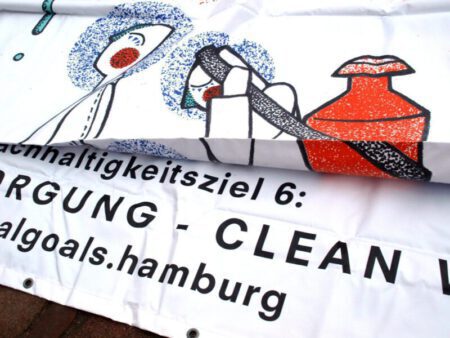
UN Sustainable Development Goal 6…
…reaffirms the necessity of ensuring, by 2030, the availability and sustainable management of water and sanitation for all people.
In addition to guaranteeing access to safe and affordable drinking water and adequate, equitable sanitation and hygiene for everyone, SDG 6 aims to:
- improve water quality worldwide through treatment and safe reuse
- significantly increase water-use efficiency across all sectors
- implement integrated water resources management at all levels
- protect and restore water-related ecosystems
“To prevent a global water crisis, the UN declared the Water Action Decade 2018–2028. At the halfway point, the second UN Water Conference took place in March 2023, resulting in a Water Action Agenda. However, this is merely a collection of voluntary initiatives and commitments to accelerate the implementation of water-related SDGs. Around the same time, the German federal government adopted a National Water Strategy, prioritizing the protection and restoration of water resources in Germany” (Global Policy Forum, 2023)
Taking Action
Since 2006, Viva con Agua (VcA), through its international network of WASH projects and in cooperation with Welthungerhilfe, has been working worldwide to improve drinking water supply and access to sanitation facilities in countries of the Global South. WASH stands for: Water, Sanitation, and Hygiene!
Their goal is for all people worldwide to have access to clean drinking water and basic sanitation. To achieve this, VcA supports a wide range of projects and initiatives both domestically and abroad. The water projects they support are sustainable and always include sanitation and hygiene components to ensure access to clean water. Volunteers and supporters are always welcome.
Further Links:
- Full text of SDG 6
- Midterm review of SDG 6 by the Global Policy Forum (2020) (available in German only)
- Federal Agency for Civic Education: International Water Consumption (available in German only)
- Viva con Agua
- Welthungerhilfe: Water and Sanitation Projects
- Water Footprint and Virtual Water Trade
- Virtual Water (available in German only)
- Water War in Bolivia (available in German and Spanish only)
- Wasseratlas 2025, Heinrich Böll Foundation (available in German only)
- International Water Conflicts, Heinrich Böll Foundation (available in German only)
- Anarchist Federation: Water Struggles Are Distribution Struggles