SDG 8: Decent work and economic growth

Sustainable Development Goal 8 is the most criticized and most controversially debated SDG. It clearly highlights the ambivalence and contradictions within the individual goals of the 2030 Agenda. Before examining this in more detail, it is first necessary to take a look at the core ideas of sustainable development and economic activity:
Economic activity is purposeful action aimed at meeting basic human needs—a planned approach that seeks to reduce scarcity and achieve its goals through rational decision-making. It follows the economic principle of achieving the greatest possible outcome with the least possible effort.
Sustainable development means meeting the needs of people living today in a way that does not limit the opportunities of future generations to live a good life. Global economic progress and prosperity can therefore only be achieved in harmony with social justice and within the ecological limits of the Earth.
Sustainable economic activity seeks to align economic action with ecological compatibility and social justice. It is not oriented toward short-term profit and increasing production, but instead aims to conserve the Earth’s resources in the long term and to improve quality of life and equal opportunities for all people. Sustainable economic growth can therefore only take place within the ecological carrying capacity of our planet; human needs and their provision can only be considered and guaranteed within planetary boundaries.
Decent work is enshrined as a human right in the United Nations’ human rights charter. Work is defined as conscious, purposeful action by each individual to secure their existence and meet their needs. Decent work is productive and provides fair incomes. It offers safe working conditions, social protection, equality, personal development, and social integration. It includes the freedom to organize, protects against discrimination, reduces poverty, and ensures dignity, security, and justice.
These ideas and development concepts lie at the heart of the 2030 Agenda and the 17 Sustainable Development Goals. However, the current global economic and labor situation is still far removed from these ideals:
Worldwide, millions of people live in (sometimes extreme) poverty despite being employed (the so-called working poor). In 2022, 28 million people worldwide were subjected to forced labor, including in agriculture, the textile industry, and raw material extraction. Around 160 million children worldwide are affected by child labor. Fifty-eight percent of the employed population—around 2 billion people—work in informal employment. Most of them have no social protection at all. The share of these precarious jobs has increased further since the COVID-19 crisis. Unemployment among young people and women has remained consistently high. Workers’ rights have also seen significant setbacks in recent years: many states have restricted, for example, the formation of trade unions and the right to collective bargaining.
Economic Growth and GDP
In industrialized societies, the traditional understanding of the economy is based on the principle of growth—that is, the continuous increase in the production and consumption of goods and services. Economic growth is equated with securing and increasing prosperity and is measured by Gross Domestic Product (GDP). If GDP grows, prosperity grows—this mantra is repeated almost incessantly in politics, society, and the economy, not only in Germany but in most countries around the world. Whether an economy is growing or stagnating has a significant impact on the political mood in a country.
GDP includes everything that is produced and sold as goods in a country each year, as well as the services that are offered and used. If people in a country earn and spend a lot, GDP rises and the economy grows. However, GDP can also grow during times of war, pandemics, or other crises, for example when the arms or pharmaceutical industries make high profits. GDP therefore does not necessarily say anything about the population’s quality of life.
For example, it makes no statements about social factors such as unequal income distribution or the extent of informal and unpaid care work; about youth unemployment and homelessness; about environmental damage, the climate crisis, and excessive resource consumption; or about (missing) prosperity factors such as healthcare, high-quality education, respect for human rights, affordable housing, life expectancy, an intact environment, or decent and living-wage employment.
Countries such as Luxembourg or Switzerland—leaders in terms of the highest per capita incomes—are also among the countries with the most unequal wealth distribution. In Ireland, which ranks second among the highest-income countries measured by GDP per capita, nearly 20% of the population lives in poverty, with the trend rising. In the United States, which still ranks seventh in terms of highest per capita income, the poverty rate is around 11.5%. And even in a wealthy country like Germany, millions of people cannot make a living from their work: around 7% of all employed people were below the poverty line in 2022.
By contrast, the happiest people are not necessarily found only in the richest countries. After Finland in first place, people in Costa Rica, Israel, and Mexico are also among the happiest (World Happiness Report, 2022).
“Gross Domestic Product measures everything – except that which makes life worthwhile,” is a quote attributed to U.S. President Robert F. Kennedy. In short, GDP as an indicator for measuring prosperity has long been controversial, especially in qualitative terms.
Can there be social justice, decent work, and ecological sustainability at all in a system based on profit maximization and continuous economic growth? The creators of the mural motif for SDG 8 give a clear answer:
“Decent work and (sustainable) economic growth are incompatible.”
You can hear more about this in the podcast with the artist LAPIZ.

Title: No Progress. In spite of technology, artist: LAPIZ
Limits to Growth: Enough Is Enough
Economic activity aimed at increasing production and maximizing profit goes hand in hand with the growing exploitation and use of ecological resources and human labor. Production and consumption cycles for goods must become ever shorter, while production costs and final consumer prices must continually fall (see the example of “fast fashion”). The remaining costs of this high level of resource consumption are ultimately borne by industrial workers in low-wage countries, by agricultural producers in countries of the Global South, by ecosystems, animals, and plants – and ultimately by all of us, in the form of work-related stress, plastic waste, polluted air, contaminated water, once-in-a-century floods, heat waves, pandemics, and more.
Earth Overshoot Day shows that each year we consume more resources than the Earth can regenerate. Globally, all the resources that the Earth can reproduce within one year were used up by July 24, 2025; in Germany, this point was already reached on May 3, 2025. From that day on, we were effectively living on credit. According to experts, we would already need three Earths if everyone on the planet had the same material standard of living as people in Germany.
As early as 1972, the Club of Rome spoke of the “Limits to Growth.” Its guiding principle was “sufficiency”: enough is enough. The study predicted that if the growth of the world’s population, industrialization, environmental pollution, food production, and the exploitation of natural resources continued unchecked, the limits to growth on Earth would be reached within the course of the next hundred years – that was 45 years ago. So far, little has been done to initiate the sustainable development called for by the Club of Rome even then, or to adequately take future generations into account.
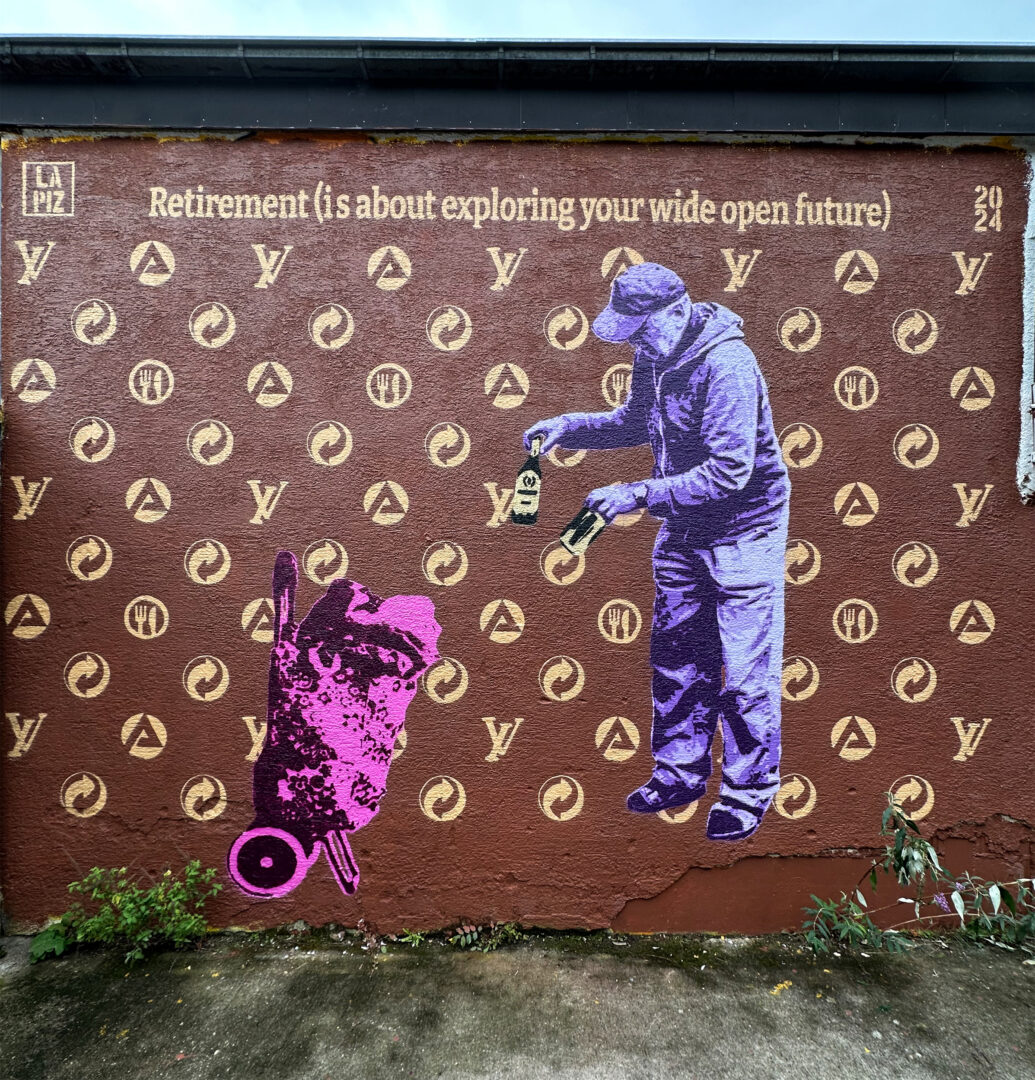
Title: Retirement (is about exploring your wide open future), artist: LAPIZ
Was bedeutet Wohlstand für Alle?
Als alternative Indikatoren für Wohlstand haben die Vereinten Nationen bereits 1990 den Human Development Index (HDI) entwickelt, der auf dem Ansatz der „Verwirklichungschancen“ beruht: Danach ist es nicht wichtig, was ein Mensch ökonomisch besitzt, sondern welche Chancen er oder sie hat, sich zu verwirklichen und die eigenen Ziele im Bereich Arbeit, Bildung, Gesundheit u.a. zu erreichen.
Ein weiterer Wohlstandindikator könnte der ebenfalls von der UN vorgeschlagenen Gender Development Index (GDI) sein: Denn die Ungleichheit zwischen den Geschlechtern hat nicht nur Auswirkungen auf den materiellen Wohlstand, sie ist auch ein Hindernis für eine nachhaltige menschliche Entwicklung.
Weitere Wohlstandsmesser sind z.B. der Better Life Index oder das Bruttonationalglück.
Sicher ist jedenfalls: Zum Wohlstand gehört die Einhaltung der Menschenrechte unbedingt dazu!
Auch die letzte Bundesregierung hat in ihrem Jahreswirtschaftsbericht 2022 neue Faktoren zur Wohlstandsmessung eingeführt wie die regionale Einkommensverteilung, Bildung, Gesundheit, die Anbindung an Öffentliche Transportmittel oder die Erreichbarkeit wichtiger Einrichtungen wie Schulen oder Krankenhäuser.
In der Agenda 2030 wird „Wohlstand für Alle“ als eine der fünf handlungsleitenden Kernbotschaften der 17 Nachhaltigkeitsziele genannt (neben Mensch, Planet, Frieden und Partnerschaft, auch bekannt als „5 Ps“ nach den englischen Begriffen: People, Planet, Prosperity, Peace and Partnership). Dazu heißt es: „Wir sind entschlossen, dafür zu sorgen, dass alle Menschen ein von Wohlstand geprägtes und erfülltes Leben genießen können und dass sich der wirtschaftliche, technische und soziale Fortschritt in Harmonie mit der Natur vollzieht.“ Nach diesem global gedachten Verständnis von Wohlstand geht es also nicht um ein rein materielles Wirtschaftswachstum, sondern es werden soziale und ökologische Belange mit einbezogen. In dieser Frage – d.h. der Vereinbarkeit einer wachstumsorientierten Weltwirtschaft mit ökologischer Verträglichkeit und sozialer Gerechtigkeit – weist die Agenda 2030 innerhalb ihrer Ziele große und ungeklärte Widersprüche auf, deretwegen sie häufig kritisiert wird. Ressourcenschonung und Wirtschaftswachstum, Gewinnmaximierung und soziale Gerechtigkeit stehen in einem bislang noch ungelösten Spannungsverhältnis zueinander. Menschenwürdige Arbeitsverhältnisse stehen im Widerspruch zur angestrebten Produktivität- und Leistungssteigerung von Unternehmen.
In keinem anderen SDG werden diese Zielkonflikte zwischen einem wachstumsorientierten Wirtschaftssystem und den Maßgaben einer nachhaltigen Entwicklung so deutlich wie im SDG 8. Es ist deshalb das umstrittenste von allen 17 Zielen. Und das vor allem deshalb, weil in ihm – trotz aller Kritik – an einem am BIP gemessenen Wirtschaftswachstum als zentraler Bestandteil der Armutsbekämpfung festgehalten wird.
What Does “Prosperity for All” Mean?
As alternative indicators of prosperity, the United Nations developed the Human Development Index (HDI) as early as 1990. It is based on the concept of “capabilities”: according to this approach, what matters is not what a person owns economically, but what opportunities they have to realize their potential and achieve their goals in areas such as work, education, health, and others.
Another indicator of prosperity could be the Gender Development Index (GDI), also proposed by the UN. Gender inequality does not only affect material prosperity; it is also an obstacle to sustainable human development. Other measures of prosperity include, for example, the Better Life Index or Gross National Happiness.
One thing is certain: respect for human rights is an essential component of prosperity.
Germany’s previous federal government also introduced new factors for measuring prosperity in its 2022 Annual Economic Report, such as regional income distribution, education, health, access to public transport, and the accessibility of key facilities such as schools or hospitals.
In the 2030 Agenda, “prosperity for all” is named as one of the five guiding core messages of the 17 Sustainable Development Goals (alongside People, Planet, Peace, and Partnership – also known as the “5 Ps”: People, Planet, Prosperity, Peace, and Partnership). The Agenda states: “We are determined to ensure that all human beings can enjoy prosperous and fulfilling lives and that economic, technological, and social progress occurs in harmony with nature.” According to this globally oriented understanding of prosperity, the focus is therefore not on purely material economic growth; social and ecological concerns are also taken into account.
However, on this issue – namely the compatibility of a growth-oriented global economy with ecological sustainability and social justice – the 2030 Agenda reveals major and unresolved contradictions within its goals, which is why it is often criticized. Resource conservation and economic growth, profit maximization and social justice remain in a tension that has not yet been resolved. Decent working conditions stand in contradiction to the targeted increase in productivity and performance of companies.
In no other SDG are these conflicts between a growth-oriented economic system and the principles of sustainable development as evident as in SDG 8. It is therefore the most controversial of all 17 goals—above all because, despite all criticism, it continues to uphold GDP-based economic growth as a central component of poverty reduction.
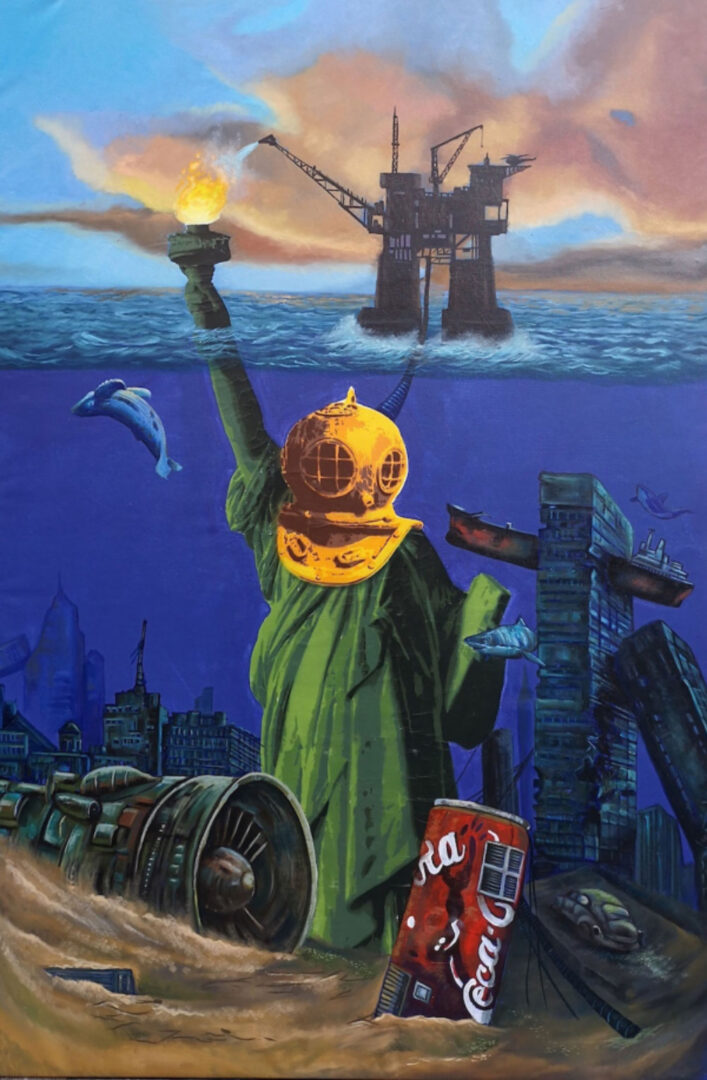
Tittle: Freedomsucker
Artist: Elmar Karla
Thea Lang Collective (Coop.with Lapiz Graffiti)
SDG 8
SDG 8 aims to promote sustained, inclusive, and sustainable economic growth, full and productive employment, and decent work for all.
In addition to promoting resource efficiency in consumption and production, decoupling economic performance and prosperity from resource use, eliminating forced and child labor, strengthening the inclusion of women, expanding needs-based financial services, and creating decent working conditions, the targets of SDG 8 also include annual economic growth of at least 7% in the least developed countries (the exact wording of SDG 8 can be found here). Ensuring such economic growth for these countries, however, would – within the framework of sustainable development – require industrialized countries to reduce their own economic growth while acting more sufficiency-oriented. This calls for a far-reaching transformation of our economic system, one that will not be possible without reducing our current standard of living. Considerable resistance from business, politics, and society is to be expected – and is already evident.
Among other things, the politically intended and legally supported implementation of the so-called “5 Rs of sustainability” is necessary: Refuse, Reduce, Reuse, Rethink, and Recycle. In German terms: refusal, reduction, repurposing, rethinking, and recycling – where refusing or avoiding the use of raw materials is the most important contribution to sustainable development and at the same time the one that most strongly contradicts the push for increased production.
Sustainable economic activity is therefore closely linked to many other SDGs – for example, responsible consumption and production patterns (SDG 12), sustainable energy (SDG 7), as well as the reduction or elimination of poverty (SDG 1) and hunger (SDG 2). Those who receive an adequate wage for decent work have more money for food, clothing, and housing and can better take care of their health (SDG 3) and education (SDG 4). Jobs with fair working conditions and wages also enable sustainable social development, greater social participation, and thus a reduction of inequalities (SDG 10) and social unrest, which threatens democratic processes. Sustainable economic activity also curbs overfishing and ocean acidification (SDG 14) as well as the destruction of terrestrial ecosystems (SDG 15), thereby making a decisive contribution to climate action (SDG 13).
Approaches and Concepts for Sustainable Economic Activity
Supply Chain Act
A consistent alignment of the economy with sustainability criteria through the legal anchoring of human rights and environmental standards for corporate conduct is still lacking. Existing business alliances (e.g. for sustainable textiles or sustainable cocoa) remain voluntary and do not oblige companies to anything. The German “Supply Chain Act,” adopted by the federal government in 2021, aims to ensure compliance with human rights and environmental standards along entire supply chains. In 2024, the EU Supply Chain Act followed, in some respects going beyond the German law. Nevertheless, both laws were criticized as too weak and full of loopholes due to the influence of a powerful business lobby. In May 2025, the newly elected Federal Chancellor Friedrich Merz announced his intention to abolish the German Supply Chain Act—despite contrary agreements in the coalition agreement—and spoke out against the planned EU supply chain directive. In June 2025, EU member states also decided on further drastic weakening of the directive.
Fair Trade
For more than 50 years, Fair Trade has been fighting against unjust global trade conditions and for decent working conditions. For fairly traded products, producers receive higher and fairer prices intended to provide them with a living income and to contribute to joint social and infrastructure projects. Fair Trade particularly promotes small-scale farming, ecological agriculture, and handicrafts.
Tax the Rich
This European citizens’ initiative advocated for the taxation of large fortunes and the introduction of a fair tax system. The goal of the initiative was a Europe-wide tax on the super-rich to finance education, healthcare, and climate protection. The signature collection for the petition ended in October 2024. Across the EU, more than 350,000 people signed, including over 100,000 in Germany. The website provides extensive background information on wealth inequality in Germany.

Title: Working with ma shiii
Artist: Elmar Karla
DIN A3, Digital Print
Further concepts of sustainable economic activity include approaches such as degrowth/post-growth, cradle-to-cradle/circular economy, sufficiency-oriented economies, and the sharing economy. These include, for example, swap boxes and swap shops such as Hamburg’s Tauschklimotte, or second-hand and exchange platforms like Vinted.
We present these concepts, as well as various Hamburg-based shops and food service businesses that strive for sustainable economic practices, on the information page for SDG 12.
Further Reading and Links
- SDG 8 – Where Do We Stand? Midterm review of the 2030 Agenda by the Global Policy Forum (2021)
- Why the Circular Economy Is So Important (2022/24)
- Good Economics for Hard Times – Six Survival Questions and How We Can Solve Them Better
A. V. Banerjee & E. Duflo, 2020, Federal Agency for Civic Education - Limiting Billionaire Power, Protecting Democracy: Report on Social Inequality
Oxfam Germany, 2025 - Prosperity and a Good Life
Eine-Welt-Presse, 2019 - Economic Growth – Why Shrinking Is Not the Solution Either
Deutschlandfunk, 2024